
Liquid Management in Nonwovens: How Hydrophilic & Hydrophobic Engineering Build High-Performance Hygiene Products
Most manufacturers confuse absorbency with liquid management.
The outdated idea is simple: the more absorbent the material, the better the hygiene product. This is the classic “sponge fallacy”.
Top-tier disposable hygiene items including sanitary napkins, baby diapers and incontinence pads are not made of uniformly absorbent materials. They are carefully structured composites that combine hydrophilic and hydrophobic zones perfectly.
Today we break down the material physics behind modern nonwoven engineering.
1. The Sponge Fallacy: Absorption Is Not Equal to Liquid Control
Many product developers treat the whole absorbent article like a sponge. If every layer soaks up liquid freely, fluids will pool on the surface and flow back to cause rewetting.
Modern liquid management follows strict physical logic:
l Step 1: Rapidly pull liquid downward without holding moisture on the top surface
l Step 2: Spread fluid horizontally across the ADL layer to avoid local saturation
l Step 3: Lock all liquid firmly inside the fluff pulp and SAP core
l Step 4: Block backflow with a fully hydrophobic backsheet
Without matching hydrophilic and hydrophobic performance, you cannot achieve this ordered fluid movement.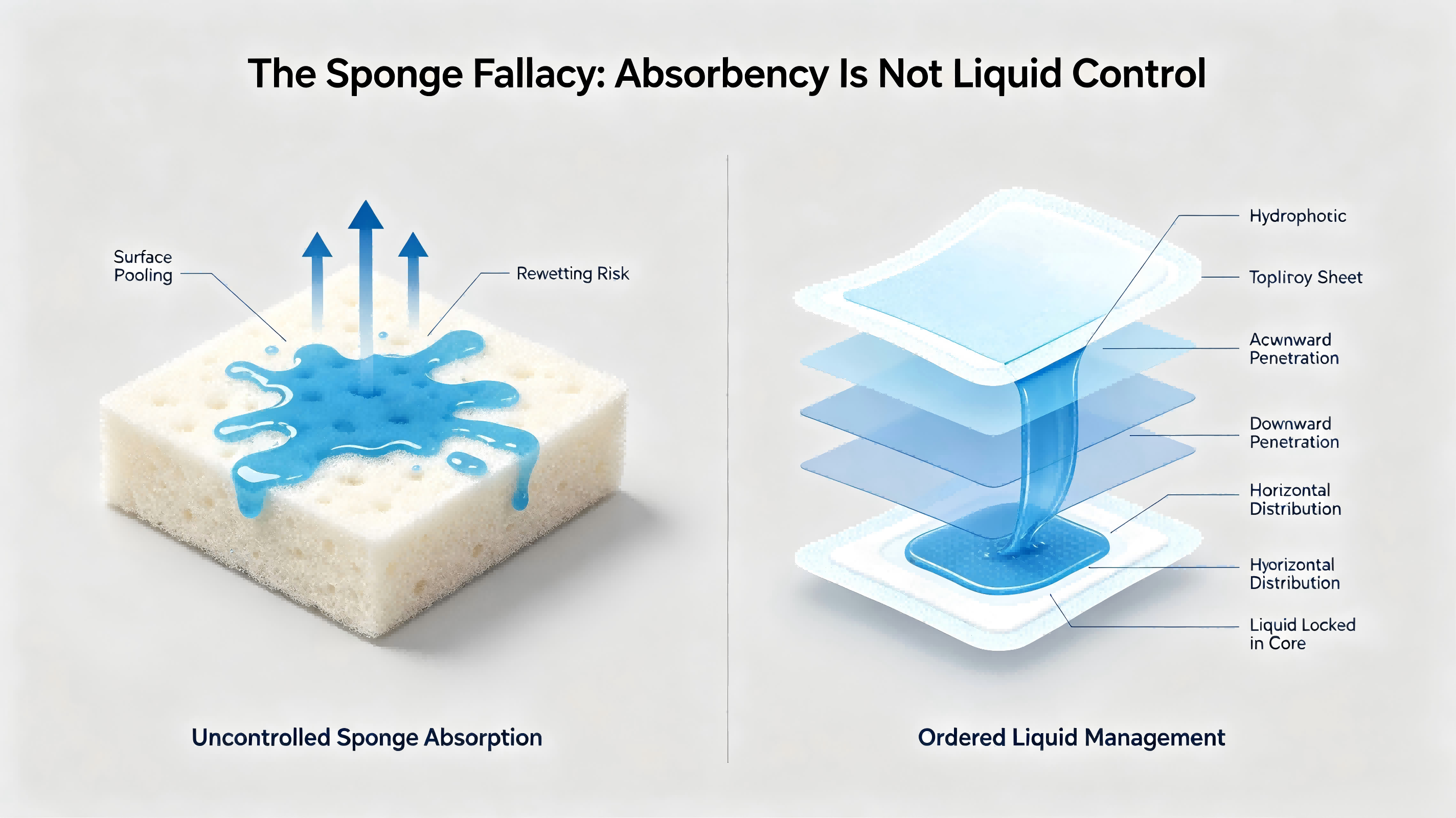
2. Core Terminology: Hydrophilic ≠ Absorbent
Two critical terms are often mixed up in nonwoven production:
(1)Hydrophilic (Wettable Surface)
Definition: The ease with which liquid spreads over fiber surface. Key index: Contact angle. Function: Let liquid pass through quickly. The top sheet only needs hydrophilicity, it should never retain liquid itself.
(2)Absorbent (Liquid Storage)
Definition: The capacity to hold large volumes of fluid. Key index: Weight absorption multiplier. Function: Trap and contain liquid inside the core.
Rule of thumb: Top sheets need to be hydrophilic, not absorbent. Absorbency belongs exclusively to the inner SAP core.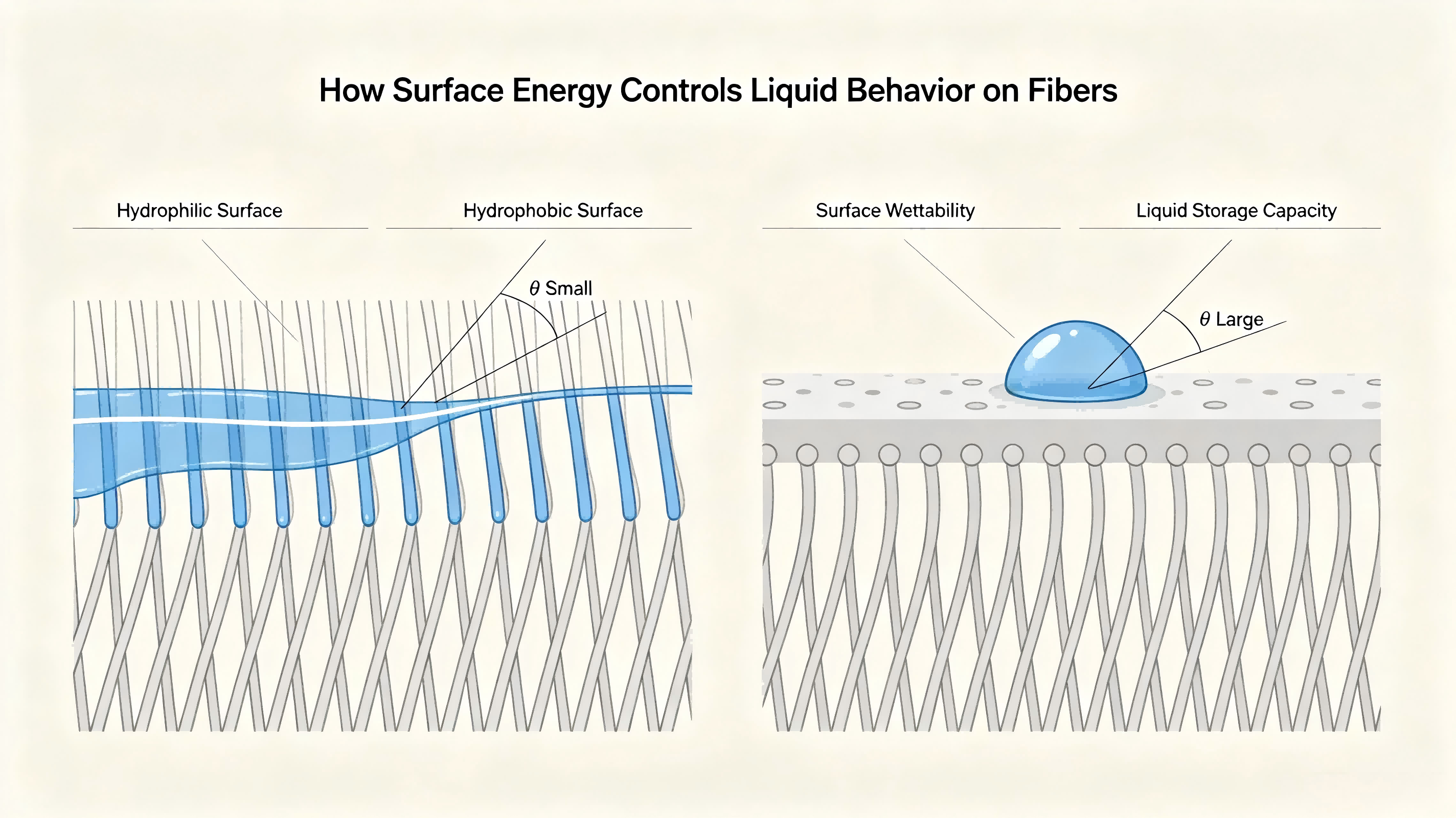
3. The Raw Material Barrier: Native PP Is Inherently Hydrophobic
Spunbond nonwoven is almost always made from polypropylene (PP), the industry standard raw material.
PP has major advantages: low cost, low density, high tensile strength and excellent chemical stability.
However, polypropylene is a non-polar polymer. It has no active hydrogen-bonding sites to interact with water molecules.
l Water surface tension: ~72 mN/m
l PP surface energy: only 29–31 mN/m
The high surface tension of water makes liquid bead up instead of spreading out. Untreated PP fiber repels water naturally.
Surface modification is mandatory to turn hydrophobic PP into a fast-penetrating hydrophilic top sheet.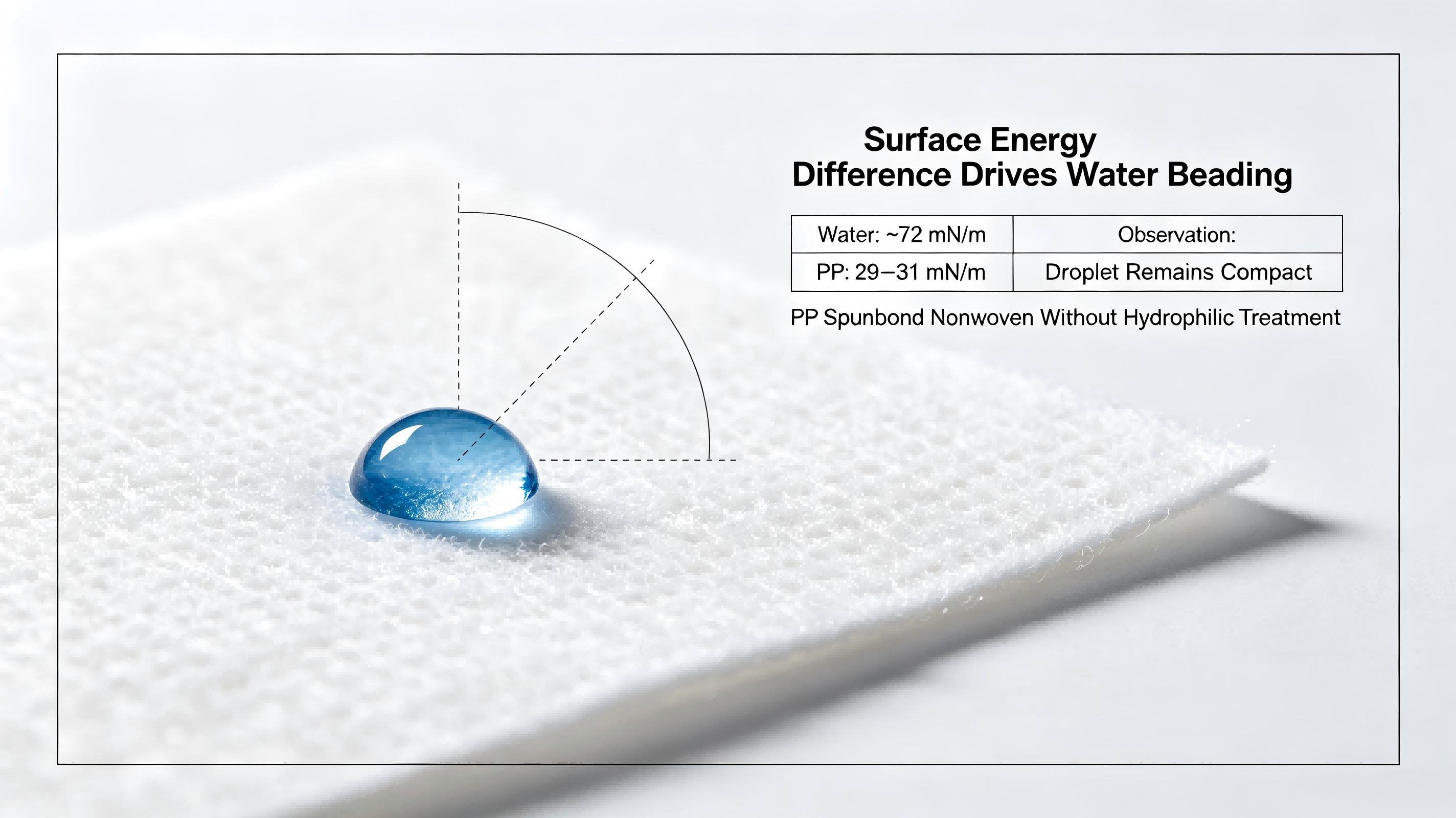
4. Technology Breakthrough: From Temporary Coating to Durable Hydrophilicity
There are two generations of hydrophilic treatment for nonwovens:
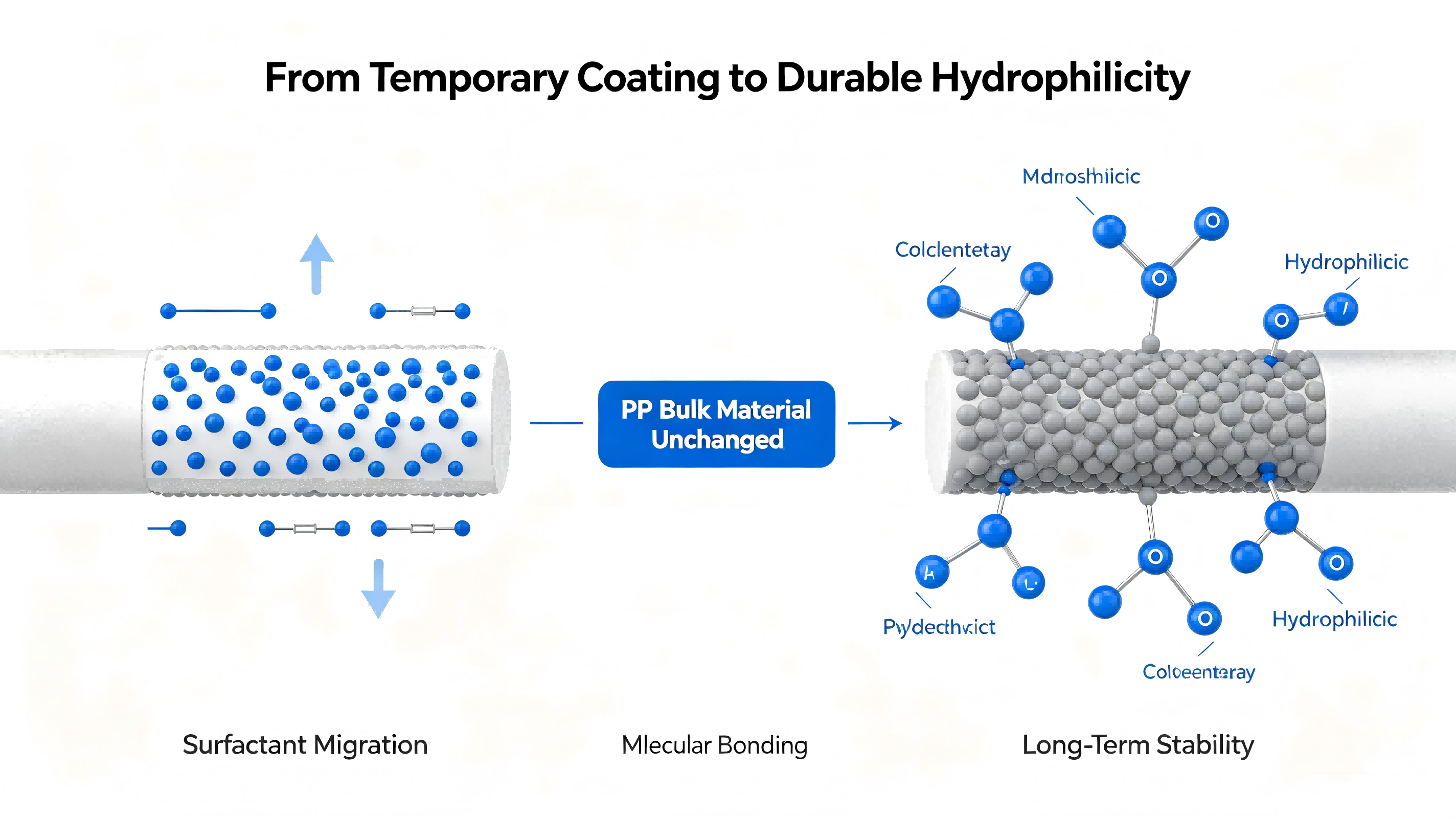
Traditional Surfactant Coating
Hydrophilic agents are simply painted onto fiber surfaces. Problem: The surfactant migrates or washes away after repeated liquid contact. Penetration speed drops sharply after use. Hydrophilic performance cannot last.
Permanent Grafting & Copolymerization
Advanced material engineering bonds hydrophilic polyether chains and hydroxyl groups directly into the PP fiber molecular structure via masterbatch modification. We only alter the nanometer-thick outer surface of the fiber instead of changing the bulk PP material. The hydrophilic groups become part of the fiber itself, delivering long-term stable permeability without migration or failure.
5. Four-Layer Engine: The Synergy of Hydrophilic and Hydrophobic Zones
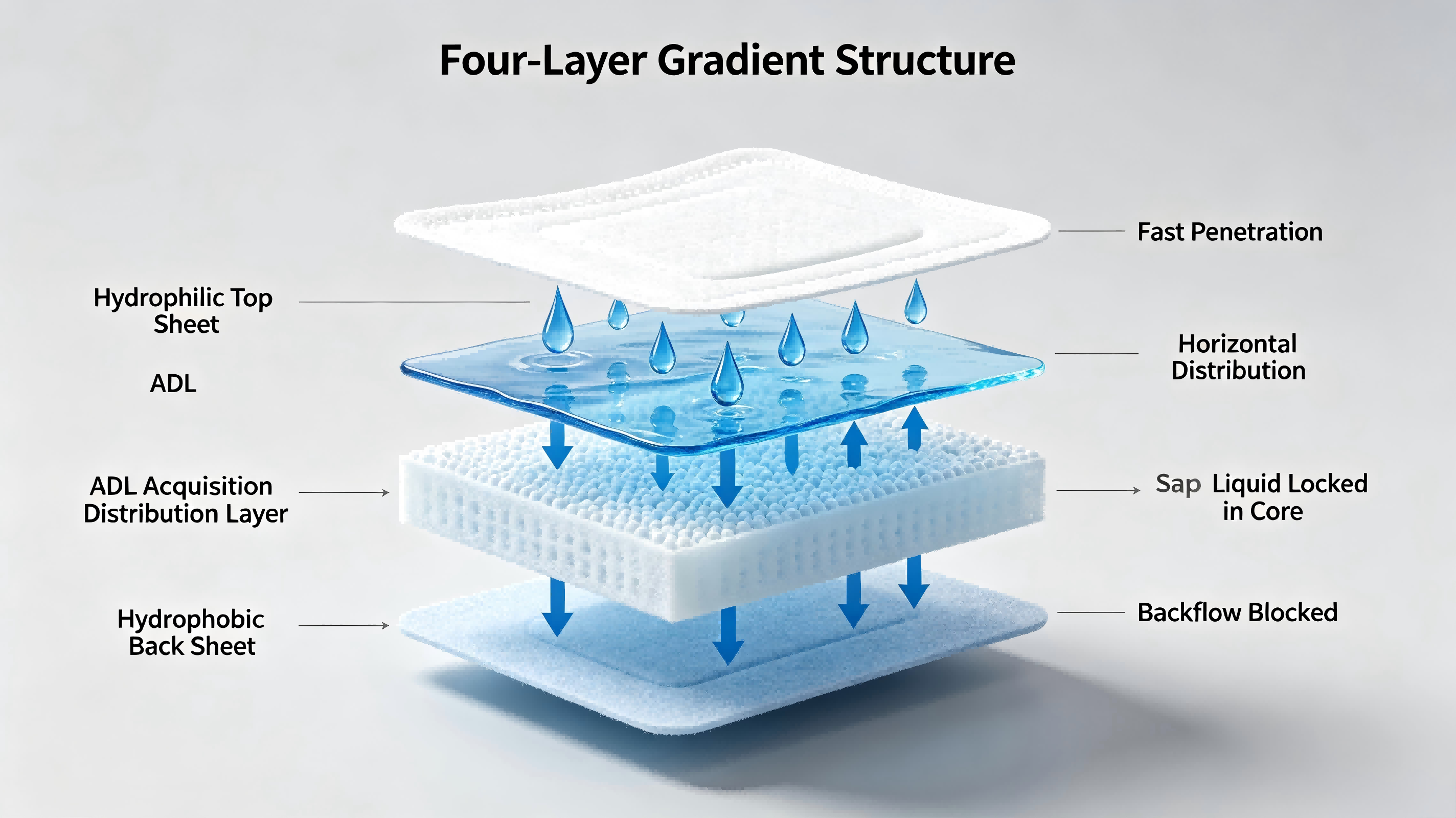
High-performance hygiene products adopt a 4-layer gradient architecture to control fluid precisely:
(1)Top Sheet (Hydrophilic Spunbond Nonwoven)
Mission: Instant wetting and fast penetration, zero surface liquid retention.
(2)ADL Acquisition Distribution Layer (High-loft Hydrophilic Fiber) Mission: Diffuse liquid sideways evenly to prevent local over-saturation and improve core utilization.
(3)Absorbent Core (Fluff Pulp + SAP Super Absorbent Polymer)
Mission: Capture and permanently store all incoming liquid. This is the only absorbent section in the whole product.
(4)Back Sheet (PE Film / Composite Barrier, Fully Hydrophobic)
Mission: Block liquid penetration completely and stop backflow to keep outer garments dry.
This layered structure builds a complete fluid channel: hydrophilic layers guide liquid downward, while the hydrophobic bottom layer seals leakage.
6. Advanced Design: Build a “Liquid Diode” with Surface Energy Gradient
Premium products take liquid management one step further by engineering a one-way transfer system.
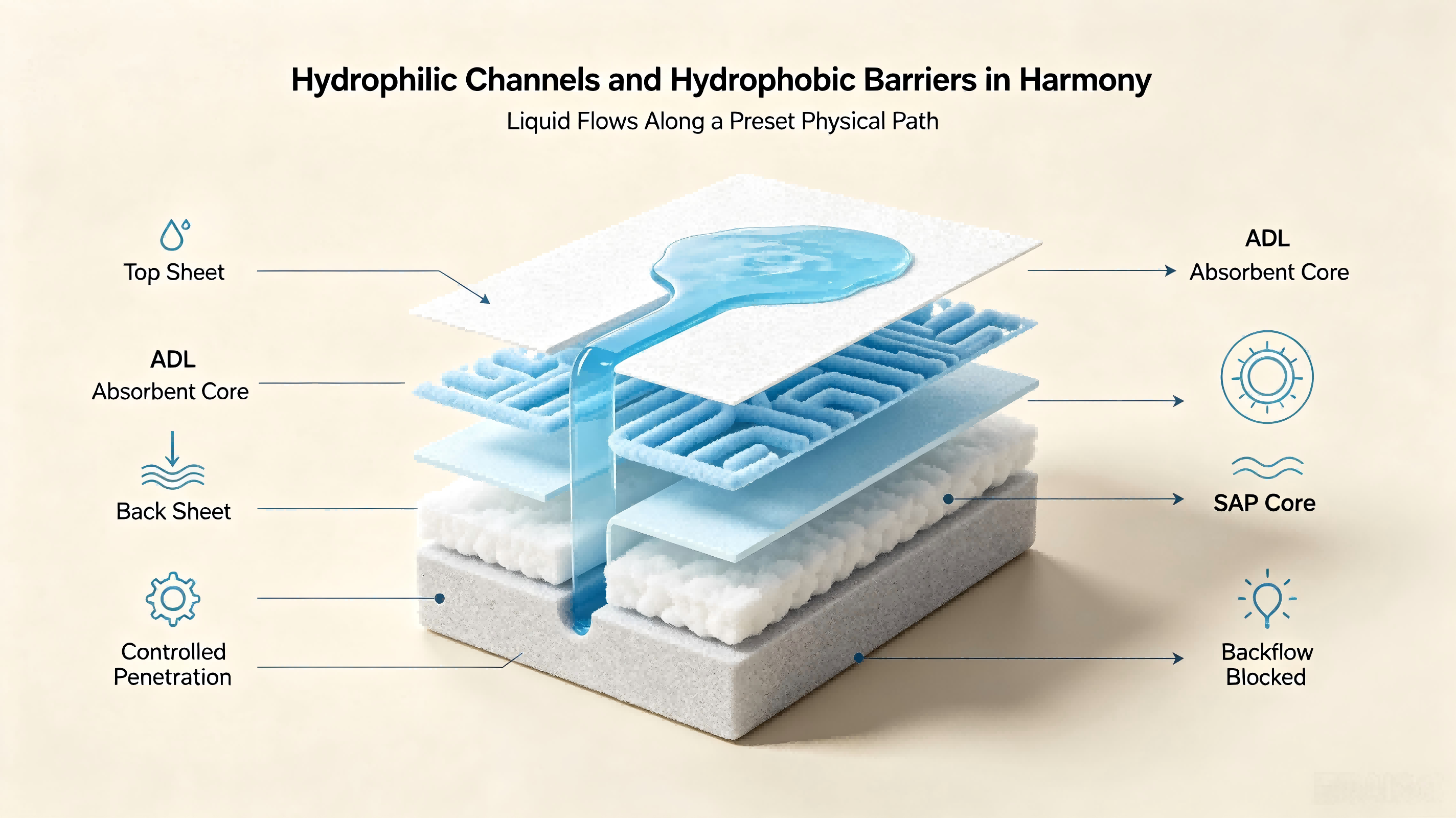
We create fiber structure gradient and surface energy gradient inside the nonwoven. Liquid flows downward effortlessly, while upward backflow is physically blocked. This “liquid diode” effect thoroughly eliminates rewetting and red staining, greatly improving dryness on the skin side.
Conclusion: Liquid Management Is the Harmony of Opposites
The core brilliance of nonwoven engineering is not making every layer absorbent. By tuning surface energy precisely, we create alternating hydrophilic flow channels and hydrophobic barriers. Liquid travels strictly along the preset physical path. The perfect match of hydrophilic penetration and hydrophobic blocking is the fundamental principle of all high-grade sanitary napkins, diapers and incontinence products.
#nonwoven liquid management#hydrophilic & hydrophobic nonwoven engineering#polypropylene hydrophilic modification#ADL acquisition distribution layer#SAP super absorbent polymer#disposable hygiene fluid control#anti-rewetting structure#nonwoven topsheet treatment#liquid diode#sponge fallacy#contact angle test#surface energy#surfactant coating#molecular grafting#sanitary napkin#baby diaper#incontinence pad#fluff pulp#hydrophobic backsheet